


MAGIEC : Geosourced Materials for Reducing the Environmental Impacts of ConstructionJunior Professor Chair
The fight against global warming is undoubtedly the greatest challenge of the 21st century. It requires a massive reduction in greenhouse gas emissions and is part of a broader effort to preserve natural resources, limit ecosystem degradation, and reduce the growing strain on transportation infrastructure, among other things. A key material for the past two centuries, Portland cement-based concrete has a major negative environmental impact. In 2023, cement production (4.1 billion tons) generated 6 to 8% of global CO₂ emissions, due to the decarbonation of limestone and the consumption of fossil fuels during its calcination.
Over the past fifteen years or so, materials made from calcined clays have attracted growing interest, particularly when it comes to repurposing local industrial byproducts (such as excavated soil and washing sludge). Ethical, cost-effective, and with a lower environmental impact, they can even improve living comfort. However, their industrialization requires a thorough characterization of their properties (mechanical, thermo-hydraulic, fire resistance) as well as a robust assessment of their durability, in order to enable their widespread use. To date, this has involved the creation of dedicated supply chains, a process requiring a long-term commitment that must be accelerated given the climate emergency.
The mechanisms of interaction between calcined clays, cements, and admixtures are still poorly understood, particularly at the physicochemical scale. Consequently, their role in the microstructural evolution and mechanical performance of LC3 materials and geopolymers remains insufficiently characterized. Clays, which are complex and multiphase materials, contain numerous minerals, organic matter, oxides, dissolved ions, etc., each of which can, after calcination, affect a material’s rheology, strength, or durability. Studying these hydraulic or alkali-activated reactive systems is essential to overcoming the technical challenges encountered in the laboratory and on construction sites.
Previous work :
Among cementitious materials, geopolymers based on sodium silicate-activated metakaolin exhibit an atypical, bimodal porosity. This characteristic gives the material unique physicochemical behavior, particularly in terms of differential variations (see figure on shrinkage). It also paves the way for innovative applications that leverage its hydrothermal properties, such as using evapotranspiration to mitigate urban heat islands.
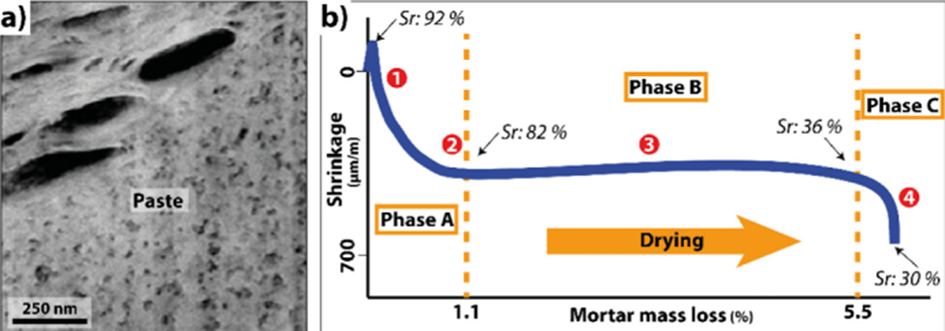
Figure : (a) Geopolymer paste, (b) Total shrinkage observed in geopolymer mortar,
image taken from Trincal, V. et al., 2022, Shrinkage mitigation of metakaolin-based geopolymer activated by sodium silicate solution. Cement and Concrete Research 162: 106993.

Vincent TRINCAL,
My background at the intersection of geosciences and civil engineering has enabled me to develop advanced expertise in clay materials, ranging from their microstructure to their applications in binders and concrete. I am proficient in a wide range of clay characterization techniques and their interpretation in various contexts: fluid–phyllosilicate interactions, activation, stability, or reactivity in cementitious matrices.
My academic research focuses on the formulation of hydraulic or alkali-activated binders based on calcined clays. My industrial experience gives me a comprehensive understanding of the entire value chain (TRL 1 to 9), from extraction to commercialization, taking into account environmental, regulatory, and performance considerations.
I now wish to develop materials based on clays that are currently underutilized or unused, such as non-kaolinitic clays derived from quarry fines, excavated soil, or dredged sediments. The goal is to transform these into new mineral additives after calcination, converting this waste into valuable and potentially profitable resources.